Stepping up: Becoming a high-potential CEO candidate
7 มิถุนายน 2569

Stepping up: Becoming a high-potential CEO candidate
Courtesy of McKinsey & Company by Carolyn Dewar, Scott Keller, Vikram Malhotra, and Kurt Strovink

Key takeaways
Since the 1950s, fewer people have made it to the top of Fortune 500 companies than those who have scaled Mount Everest. While there is no way to guarantee success, if you’re a senior executive who aspires to the top job, the following advice can greatly increase your chance:
· Take a gut check of your motivations and expectations.
· Elevate your perspective while boldly delivering results.
· Round out your profile with humility.
· Understand the CEO selection process and put your best foot forward.
Take a gut check of your motivations and expectations
To ensure that your motivations are sustainable, it is crucial to think through the main reason you want to be a CEO. The following table shows a short list of motivations and expectations that provide a good checklist for whether you’re well suited for the top role.
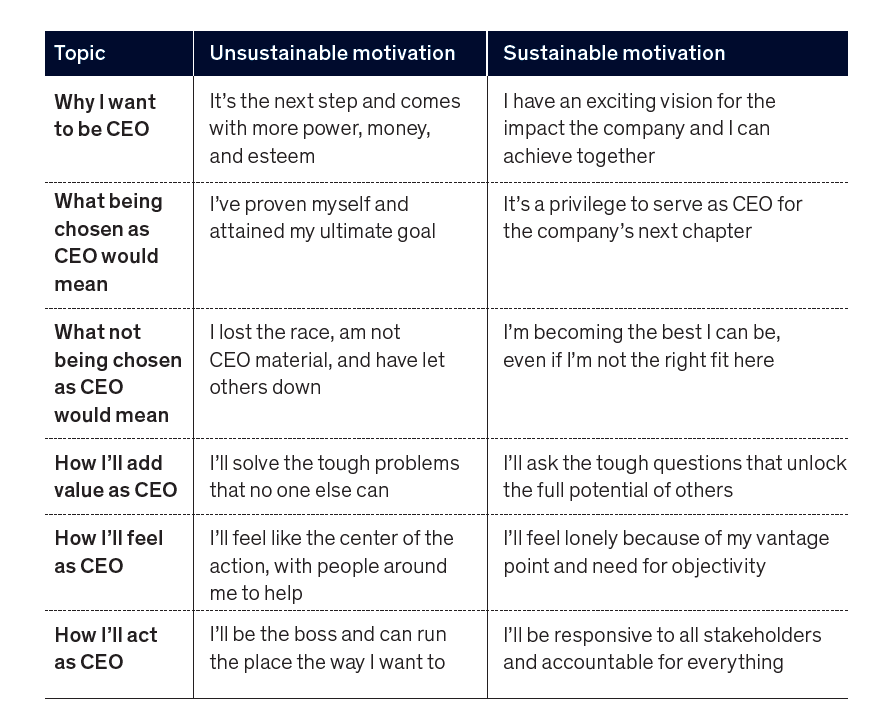
Without the right motivations and expectations, not only will you find that the effort required to be CEO outweighs any personal gain, but you will also be less likely to succeed. For these reasons, we encourage any executive setting their sights on the summit to do some genuine soul searching before deciding to make the final ascent.
Last, when taking a gut check of your motivations and expectations, don’t forget to consider the impact that the new job will have on your family members. Indeed, virtually every successful CEO we’ve worked with has shared that having a spouse or partner who understands and is supportive of the nature of the job is essential. Your life will not be the same once you become a CEO, hence make sure that your family is supportive of your decision.
Elevate your perspective while boldly delivering results
In 2002, Harvard Kennedy School professors Ronald Heifetz and Marty Linsky introduced a new metaphor into management literature—the concept of “getting off the dance floor and going to the balcony.” The metaphor juxtaposes delivering on daily work (being on the dance floor) with stepping back and seeing the big picture (being on the balcony). The most effective leaders, according to Heifetz and Linsky, are those with the ability to do both at once.
As your candidacy for the top job develops, it’s vital that you keep the following actions in mind:
When it comes to being on the balcony, there are three perspectives you’ll want to hone. The first is looking into the future of your industry, as Microsoft’s Nadella says that to be a successful CEO, “You have to have an absolutely first-class view of where the world is going.”
The next viewpoint involves looking more broadly across the whole organization—far beyond your area of responsibility. Some reliable ways to broaden your perspective during the final ascent are to get involved in enterprise-level projects, committees, and development programs; invest time in getting educated in other areas; and take an explicitly company-first perspective in your decision making.
The third view from the balcony peers over the stakeholder landscape. CEOs of today’s large companies must have a point of view on a wide variety of societal and environmental issues. Therefore, they need to have their pulse on employee, customer, and board sentiments and use them to help shape their company’s principles as issues emerge.
However, a point to be cautious about on your day job and long-term perspective is risk aversion. Companies led by CEOs who lack the courage to make bold moves are unlikely to outperform the competition. Instead of saying to yourself, ‘What I’ve done is enough.’, you could try stepping up with boldness. Such boldness can help you stand out from your peers in the eyes of the CEO and board as the right leader to take the company into the future.
Round out your profile with humility
As an aspiring CEO candidate, it’s important to have the humility to recognize your inherent self-serving bias and counteract it:
· Objectively assess your capabilities versus what’s needed.
· Fill your skill gaps and gauge your progress on the way.
· Refuse to play politics in the process.
Assessing your capabilities starts with understanding what the company needs in its next leader. If you’re a candidate, first ask yourself in an intellectually honest way, ‘What does the company most need?’ And ‘Do I have that skill set today?’”
To understand the extent to which you’ve got what the company needs, break your abilities down into at least four dimensions. The first is your breadth of experience and record (for example, leading transformational change, delivering a profit-and-loss statement, and representing the company externally). Second is your knowledge and expertise (for example, financial acumen, sales leadership, technology, target markets, and industry trends). The third is your leadership skill (for example, strategic thinking, executive presence, team building, and self-awareness). Finally, how strong are your relationships, and what is your reputation? How are you viewed by internal stakeholders, such as your boss, peers, direct reports, and influencers? How about by external stakeholders, such as investors, customers, suppliers, regulators, and community leaders? And how about by board members?
One important point that can help you have a better self-understanding is to collecting 360-degree information by asking an external coach to gather such input. This is mainly to help you have an objective point of view, that is crucial to overcome your self-bias.
Once you’ve assessed how you stack up in the four dimensions, it’s time to start improving yourself. Think of it as embarking on a learning journey that involves cycles of taking action and then reflecting with a close group of advisers on the progress being made. Such journeys typically combine ongoing leadership coaching with participation in various forums or roundtables, visits to other companies, targeted reading lists, briefings from experts, and finding opportunities to gain experience and build relationships (for example, dealing with the media, presenting to the board, and representing the company externally).
Going on such a journey requires striking a delicate balance. You’ll want to increase your visibility to ensure that those who need to know are aware that you want to make the final ascent without being seen as self-promoting or currying favor.
On top of that, as Westpac’s Kelly shares the keys to success are to not playing politics nor undermining people. Instead, you should show your authenticity, transparency, and be a team player, and an active supporter of colleagues for the greater good, even if they are also in the running for the role. Again, this reinstates the importance of taking a gut check of your motivations and intentions. If they’re not sustainable, you simply won’t be able to walk the line with authenticity.
Understand the CEO selection process and put your best foot forward
While every board’s process is unique, CEO selection process will typically involve the following steps:
Below is our top ten list of subtle but high-impact advice for putting your best foot forward in the formal selection process based on our experience:
The ascent to the CEO role is like reaching the summit where beauty and wonders are experienced during the climb. The learning from the journey will be invaluable and, more than likely, set you in good stead to summit other beautiful mountains if that remains an aspiration. If you do set foot on the highest peak, we’ll offer our congratulations—you’re among the world’s most elite business mountaineers.
To read the full article, please visit https://www.mckinsey.com/capabilities/strategy-and-corporate-finance/our-insights/stepping-up-becoming-a-high-potential-ceo-candidate#/
About the author(s)
Carolyn Dewar is a senior partner based in McKinsey’s Bay Area office. Scott Keller is a senior partner in the Southern California office. Vikram Malhotra is a senior partner in the New York office where Kurt Strovink is also a senior partner.
The authors wish to thank Ivo Bozon, Blair Epstein, Selin Neseliler, Jen Whitaker, and Jessica Zehren for their contributions to this article.